

Kurdish
My mother tongue of science

The lead-up
ZAGROSCIENCE is the stone with which I am trying to kill the two birds of intellectual catharsis and knowledge dissemination. First, it gives me the freedom to creatively express the rational contents of my mind in a way that the constraints of academic writing for the purposes of peer-reviewed publications categorically deny. Second, it provides me with an outlet to promote neuroscience to a broad readership—with Nobel Prize recipients, University Professors, artists, Olympians, free thinkers, and laymen all constituting demographic groups that subscribe to my platform. What I did not expect, however, is that it would bring me even closer to my Kurdish roots. In this issue of ZAGROSCIENCE, I will not only relate the contents of my mind, but I will also lay bare those of my heart as I walk you through what it was like to be me, hearing for the first time in my life at an academic conference, my beautiful mother tongue being spoken to communicate science.
I launched ZAGROSCIENCE back in mid-May, not knowing that it would catch the eye of one of the subcommittee members of an upcoming academic event. At the time, I was vaguely aware that some kind of a gathering of Kurdish scholars was slated for later in the year, but its significance did not register with me right away. The person in question was a family friend who had reached out to me after seeing my inaugural ZAGROSCIENCE video—which you can watch by following the link below:

He congratulated me on starting my online neuroscience platform and invited me to partake in what would be the first international scientific convention of Kurdish academicians. Scheduled for end of August at the University of Ottawa in the heart of Canada’s capital city where I happen to live, I looked into the event and thought to myself, “why not?” After all, I am Kurdish, I am a neuroscientist, I happen to be a good public speaker, and the conference is looking for lecturers. So I completed the online form, submitted my application, and paid the registration fee.
Throughout my academic career, I have attended numerous scientific symposia, but it became immediately apparent to me that I was on the verge of embarking on something truly unique this time. For starters, unlike other academic conferences that typically deal with highly specific subject matters, this one was very broad in its scope, promoting collaboration between researchers from very different fields. Additionally, the guidelines required that, in tandem with an English abstract, another written in one of the main Kurdish dialects be submitted. Without getting too much into history and politics, it is important to state that due to generations of oppression and persecution by Turkish, Persian, and Arabic governments that collectively rule over Kurdistan, the ancestral homeland of the Kurdish nation, only a minority of Kurds are educated in our mother tongue—and I, myself, happen to be part of the overwhelming majority unfortunately. While I have always spoken Kurdish at home, I was never actually taught Her alphabet, neither the Kurdo-Arabic nor the Latin-based version. In fact, I am exclusively self-taught, which was not the easiest thing for me to do in my late twenties when I started familiarizing myself with both variations. Suffice it to say that drafting my abstract in my own mother tongue was anything but plain sailing. Still, I managed with the help of online translation interfaces and thanks to the kind editors of the organizing body.
After weeks of waiting, I finally got an email on July 15 that read:
We are pleased to inform you that your submission has been provisionally accepted. We greatly appreciate your contribution to the 1st Hojan Science Forum.
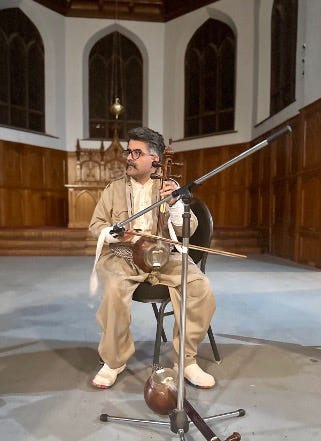
Hojan, what a beautiful name! In Kurdish, it means learning. And the part about provisional acceptance essentially implied that my talk was all but etched in stone pending minor amendments to my abstracts. The stage was set—I was going to deliver a lecture on memory and consciousness at the first international convocation of Kurdish scientists. It was around the same time that I also found out that my older cousin, Showan, who holds a PhD in music from Université de Montréal and is one of the leading experts in the Kemançe, would be performing live at the event’s cultural night. Getting off the phone with him that night, I could not help but to think about our deceased grandfather. How proud of us he would have been to learn that we—his grandchildren, hailing from the historically revolutionary city of Mehabad in Eastern Kurdistan—would be participating in our respective capacities in the world’s first Kurdish science forum in the capital city of Canada. The whole thing was just so surreal—I am getting goosebumps just writing about it.
I was not ready for what came next. As I was preparing for my talk in the weeks leading up to Hojan, I decided to take a closer look at the guest lecturers and keynote speakers on the official website. I became flummoxed as I realized just how many top-tier Kurdish scholars I saw on the list; Harvard, Max Planck, McGill, University of Toronto—it was a who’s who of academic excellence, and I was not prepared in my dispossessed Kurdish mind to accept that so much intellectual greatness had sprung from the largest stateless nation in the world. Two names in particular stood out: Caucher Birkar and Ebrahim Karimi. The former, whose name literally translates to “migrant mathematician,” is the 2018 laureate of the Fields Medal. For those who do not know what that is, think of it as the Nobel Prize of mathematics awarded every 4 years! The latter is the recipient of numerous prestigious honours in the field of physics, including the Herzberg Medal and the Rutherford Memorial Medal. He is also the Tier 1 Canada Research Chair in Structured Waves and Quantum Communication. Other notable speakers included German physicist, Gerd Leuchs, who is the Director Emeritus at the Max Planck Institute for the Science of Light, and Jaffer Sheyholislami, Professor of Applied Linguistics at Carleton University, fellow Mehabadi, and also someone with whom I had a rather telling tête-à-tête in the men’s washroom during intermission on the second day of Hojan—more on that later…
Day 1 of Hojan (August 25)
Finally, the first day of the forum had come. The venue, the Desmarais Building of University of Ottawa, was only a 10-minute drive away from where I live. I called an Uber at around 7:50am, leaving my own car at home for my wife and daughter. My driver was an Arabic gentleman by the name of Elias. We started talking and he asked me where I am from—I replied, as I always do, “I’m from Kurdistan.” He proceeded to inquire more about me and when he found out that I did not speak Arabic, he seemed a bit perplexed. So I explained to him that unlike Southern and Western Kurdistan, which are officially under the federal jurisdictions of the Iraqi and Syrian governments respectively, the state-sanctioned languages in Northern and Eastern Kurdistan are not Arabic. In fact, I elaborated that where I am from, Eastern Kurdistan, the officially recognized language is Persian (or Farsi). Once it dawned on him that I speak Persian instead of Arabic, he asked me another question that caught me off guard, “But why not Arabic?” He then proceeded to elaborate on how knowing Arabic is a much more useful linguistic feather in one’s cap than knowing Persian. Be that as it may, I deferred back to the fact that I had absolutely no say in that my formal education was in Persian—and not Arabic—as a child growing up in a country ruled by Persians. If it had been up to me, I would have much rather learned my own forsaken mother tongue at school. Do not get me wrong, I believe that the more languages one speaks, the richer one’s soul is, which is why I consider myself spiritually wealthy as a polyglot who speaks five languages. Even so, there is simply nothing like one’s own mother tongue, and from my vantage point, no language on Earth could ever hold a candle to the fire that is Kurdish.
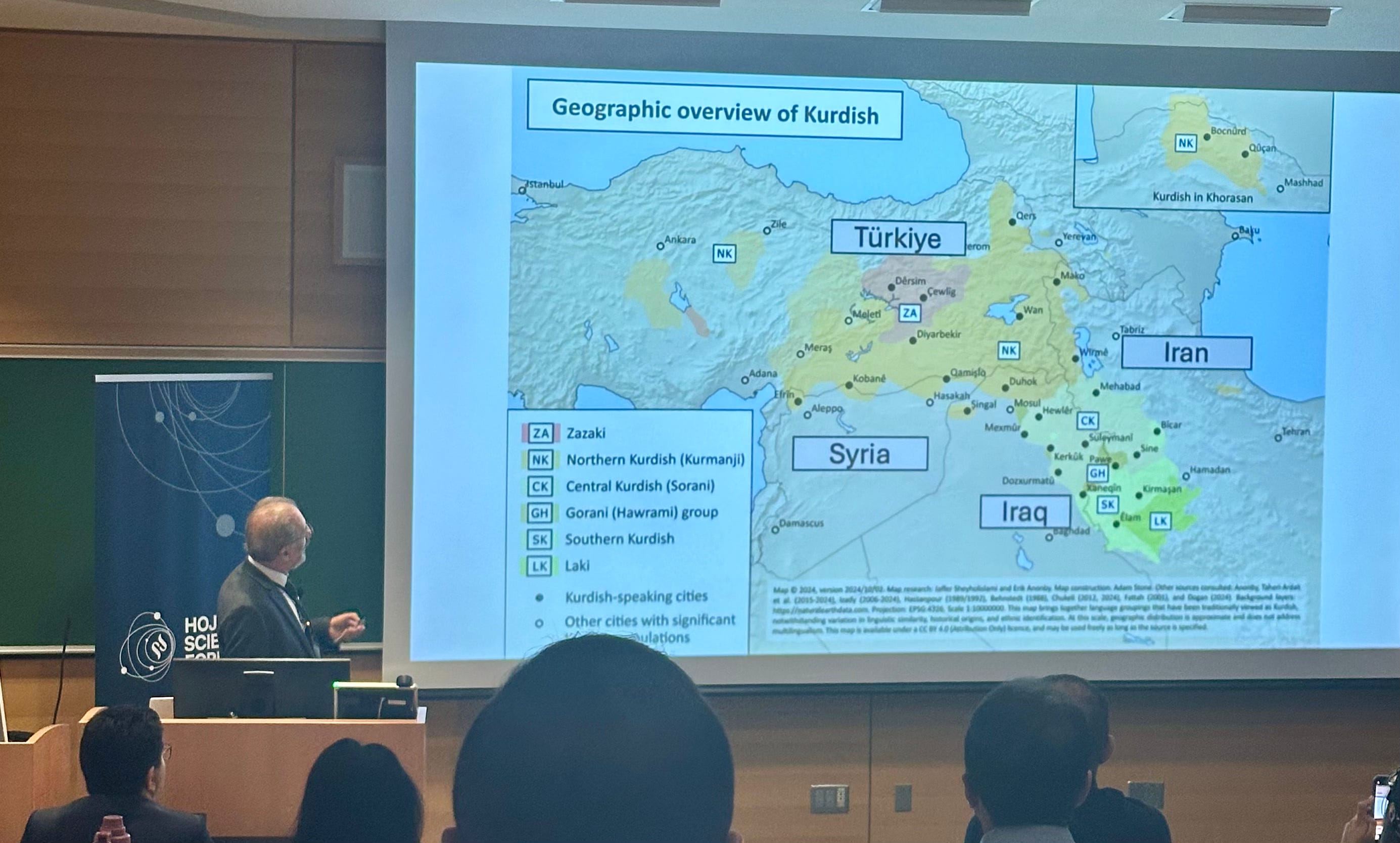
Interestingly, the first keynote lecture at Hojan was all about language and the different roles it plays, which, according to the speaker, the aforementioned Kak1 Jaffer, boil down to three overlapping functions: expressing one’s identity, communicating with others, and sharing knowledge. Unfortunately, expressing one’s Kurdish identify in certain parts of Kurdistan may communicate the wrong kind of knowledge to the powers that be. As explained by Tevfik Bayram, a PhD candidate at Université de Montréal and winner of the highly distinguished Vanier scholarship, speaking Kurdish can sometimes condemn one to less than favourable circumstances in Turkey. Kak Tevfik, who additionally went on to receive an award at Hojan for his amazing presentation, described how hospital mortality rates for Kurdish speakers are significantly higher than those for Turkish speakers. He shared a particularly disheartening story about a Kurdish girl from a rural community in Northern Kurdistan who died at a hospital in Amêd (Diyarbakir in Turkish), the largest Kurdish-majority city in the world, in which healthcare is only provided in Turkish. He argued that she might have survived had she received treatment in her mother tongue—or at the very least, her final moments might have been spent in a more humane environment. In a private correspondence with Kak Tevfik, he informed me that Kurdish patients will oftentimes speak of these matters very subtly, which according to him, is a manifestation of the political oppression under which they live.
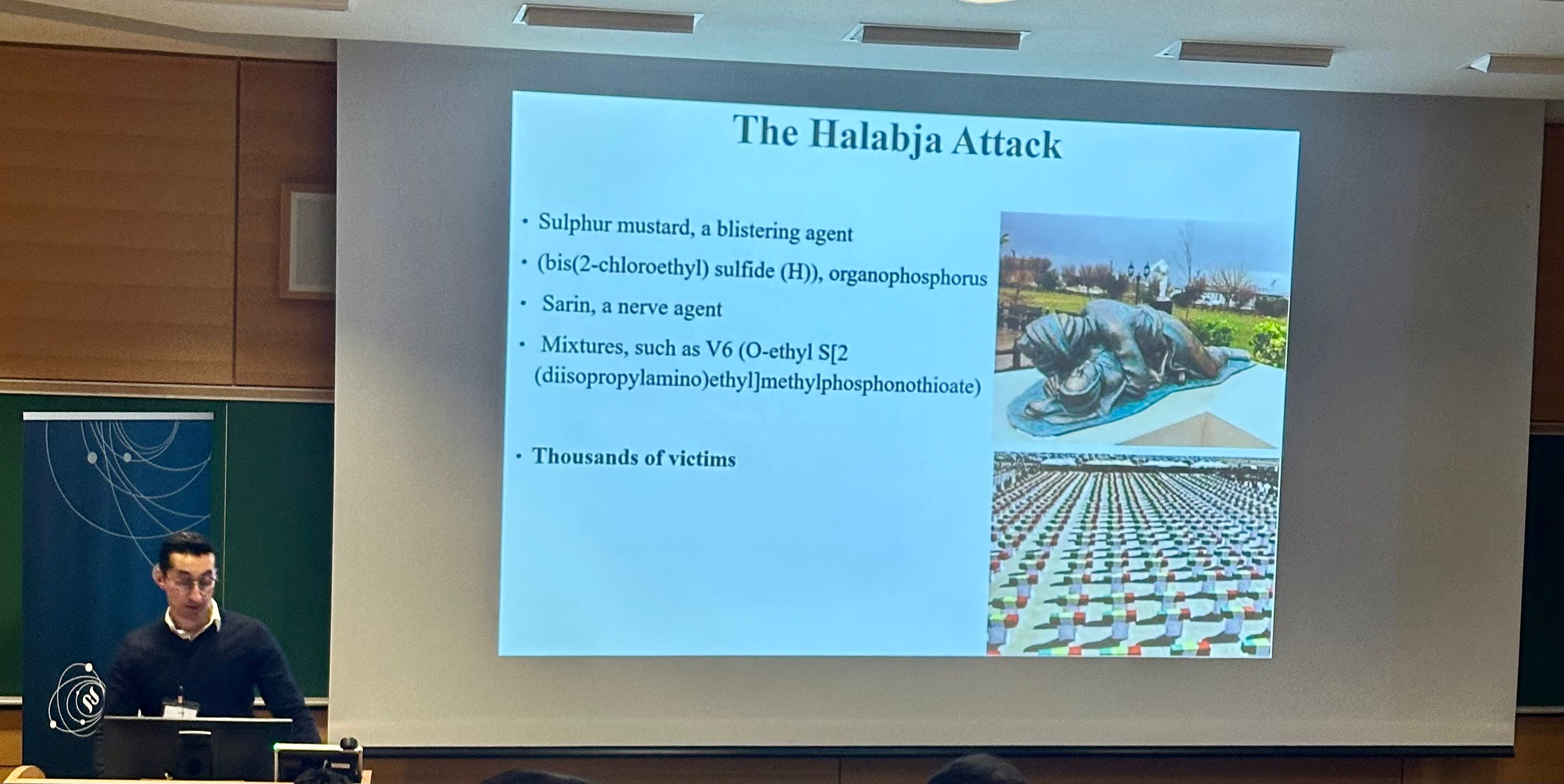
Another presentation that stood out to me was the one given by Aram Ghalali, a Harvard scholar with dual postdoctoral fellowships, who shared sobering facts about the ongoing genotoxicity in individuals from the city of Helebce in Southern Kurdistan. Helebce bore the brunt of Saddam Hussein’s genocidal Anfal campaign in which some 200,000 Kurds were killed. On 16 March 1988, the city’s population became the target of aerial strikes carrying chemical compounds including mustard gas and various nerve agents, murdering thousands of innocent lives in a matter of minutes, making the Helebce massacre the largest chemical attack perpetrated against civilians in modern times. As Kak Aram described, three and a half decades since the atrocities, the negative effects of the chemicals continue to fester in the environment, manifesting as intergenerational health-related complications in the denizens of the city.
Day 2 of Hojan (August 26)
The keynote lecturer in the morning was Gerd Leuchs who talked about how science can shape society for both good and bad, all depending on how it is used. At the outset, he mentioned Yuval Noah Harari’s acclaimed book Sapiens, which got me thinking about something he and I had discussed about the day before. Following the talk and the applause that ensued, I brought up an important point during Q&A. I reminded Gerd, and everyone in attendance, that I had told him about a recent paper by the Max Planck Institute that had been published in Science, one of the most prestigious peer-reviewed journals. The article in question—Heggarty et al., (2023)—analyzed phylogenetic linguistics in conjunction with ancient DNA to identify the geographical origins of Indo-European languages. The authors determined that the epicentre of propagation was located in the northern Fertile Crescent, with the Zagros mountains of Kurdistan as a the main hub, dating back to approximately 8,000 years ago:
This CHG2/Iranian component is found first south of the Caucasus, including in the north to northeastern arc of the Fertile Crescent, among early farmers on the flanks of the Zagros Mountains in western Iran […]
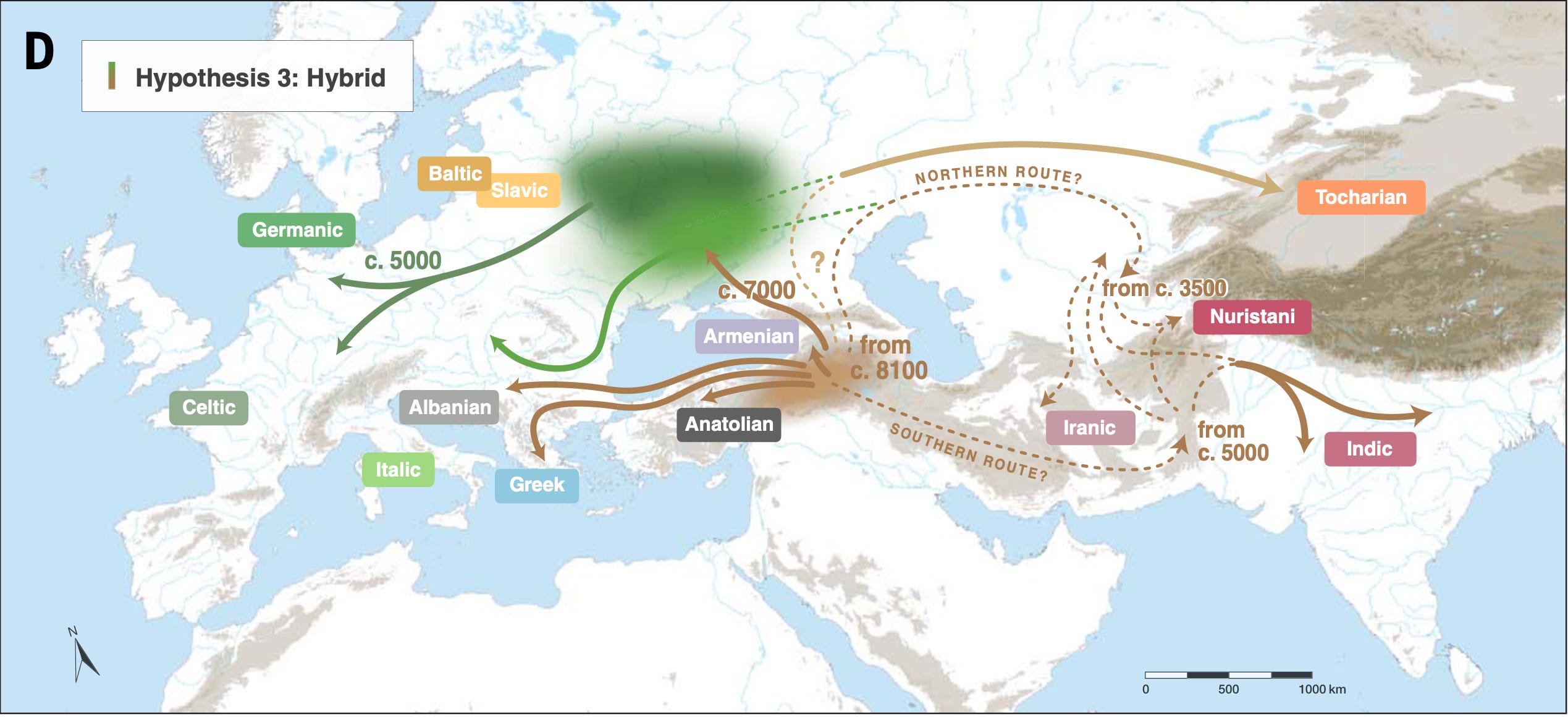
I told Gerd that while there exists a wealth of published work on Kurdistan, the authors somehow always manage not to actually mention the word “Kurdistan.” To refer to the different parts of my homeland, writers will invariably use politically-correct euphemisms like “southeastern Turkey” or “Anatolia”, “northwestern/western Iran” - as in Heggarty et al., (2023), “norther Iraq”, and “northern Syria”. It is almost like the largest nation without a country is not only not allowed to have a state, but is also unworthy of even being mentioned in academia. Personally, I take great issue with the misappropriation of my history, language, land, culture, and heritage. And Harari, as I informed Gerd and the members of the audience, is guilty of the same kind of je-m’en-foutisme as anyone else who has failed to mention Kurdistan when speaking about Her. Here is a snippet from his highly touted Sapiens pertaining to the origin of agriculture—see if you can think of a single word to sum up the geographical region in question:
The transition to agriculture began around 9500-8500 BC in the hill country of south-eastern Turkey, western Iran and the Levant.
Well, well! Who would have thought that the spread of agriculture had something to do with the spread of language? Indeed, both began in Kurdist… [apologies, I am experiencing technical difficulties] So I pleaded with the Kurdish scholars in attendance to try and put an end to this campaign of censorship in their own works. I can only hope that my admonishment did not fall on deaf ears, but only time can tell.
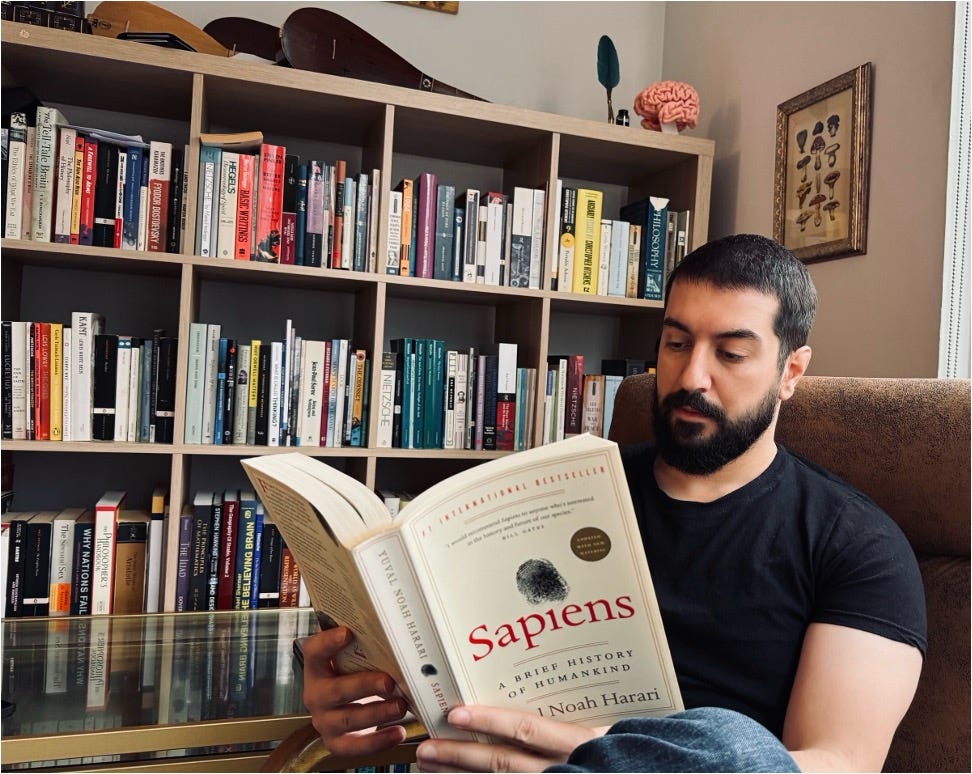
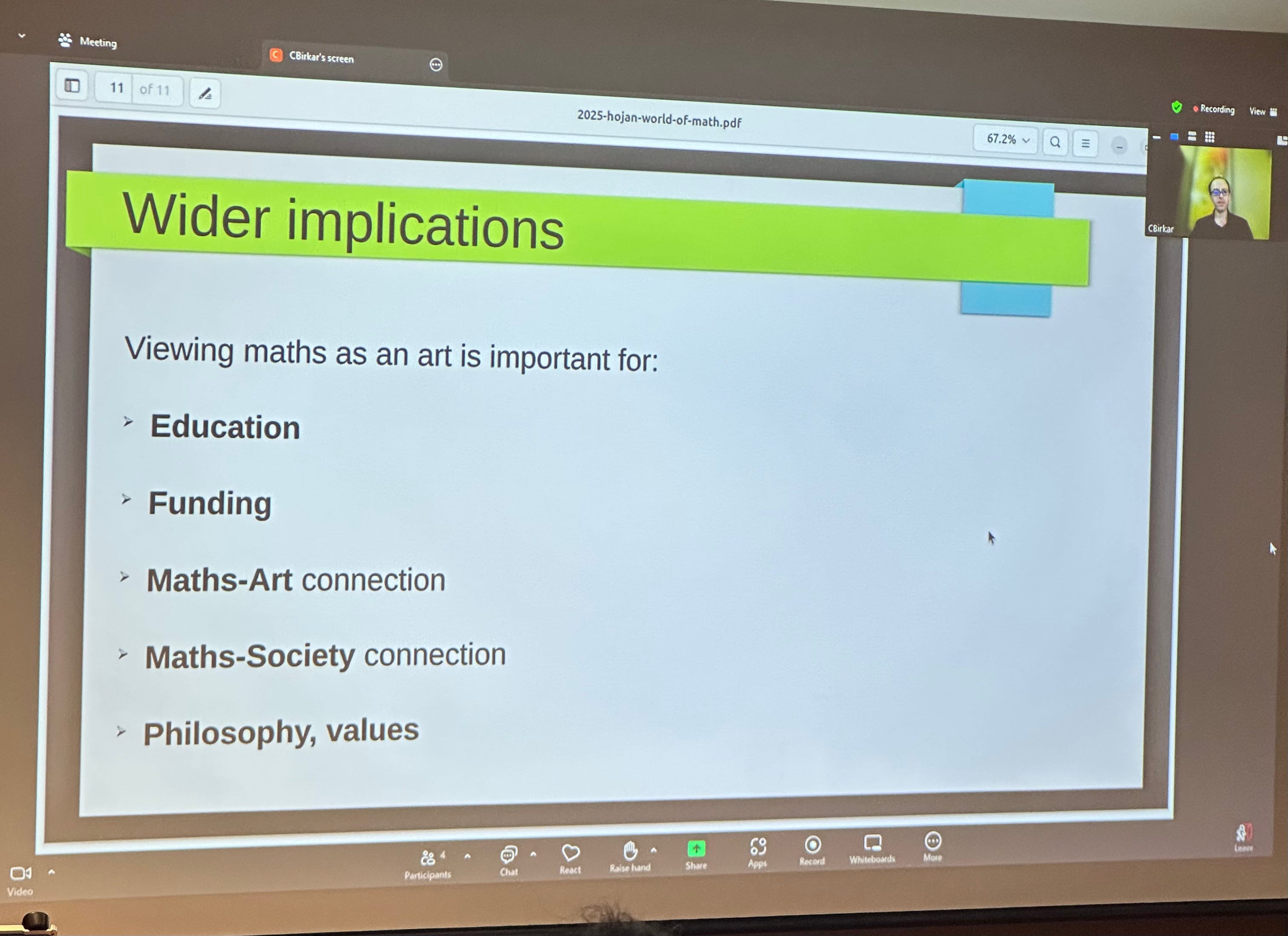
Before noon, Caucher Birkar joined in remotely to give his presentation on the relationship between mathematics and art. It was something to behold, watching a Fields Medal laureate discuss, in Kurdish, the philosophical underpinnings that unite the two domains. Later during lunchtime, I ran into Kak Jaffer inside the men’s restroom. As we were both washing our hands, he informed me that he personally knew some of the authors of the Heggarty paper, and that he had brought up the same issue of censorship to their attention in the past. Asking them why they never mentioned Kurdistan in their article, he was met with the usual platitudinous excuses one gets in such circumstances based on my own personal experience—that no one knows where Kurdistan really is, that it is not an officially recognized country, that no one wants to get into politics, or that all borders are imaginary constructs anyway. By the way, this was also Gerd’s reply, that all borders are imaginary. But when you are a Kurd, you quickly come to understand that some borders are more imaginary than others. As the Orwellian commandment reminds us, “All animals are equal but some animals are more equal than others.” So when the authors of the Science article were writing about the “Zagros Mountains in western Iran” being at the epicentre of all Indo-European languages, they knew they were actually referring to the “Zagros Mountains in Kurdistan.” And this, ladies and gentlemen, this reluctance to call a spade a spade when it comes to the Kurds is how you relegate the native population of the Fertile Crescent to a mere footnote in the annals of history, if we are so lucky!
Day 3 of Hojan (August 27)
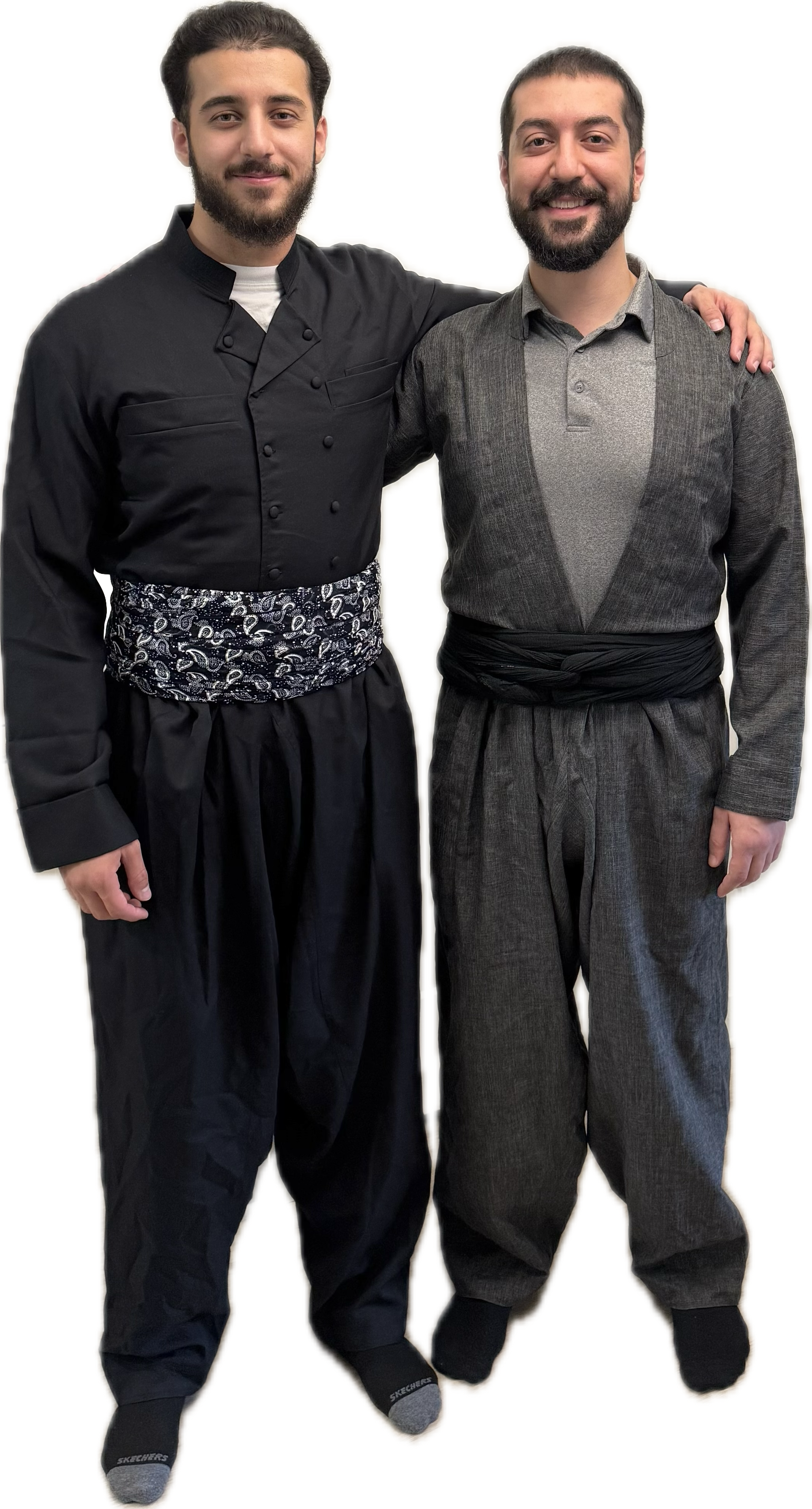
For the life of me, I could not find my traditional Kurdish attire to wear for my talk, which was scheduled before lunch. I ended up presenting much later in the afternoon due to significant delays in the programming, that is, due to everything running smoothly according to Kurdistan Standard Time! I must admit, Day 3 was the highlight of Hojan for me, not only because I delivered a rather solid presentation, but also because I spent the whole day with my brother-in-law, Yagi—not to mention the amazing afterparty during cultural night, where Kake Showan performed live. Yagi and I have a running joke that ours is the greatest bromance since Gilgamesh and Enkidu!
He had helped me rehearse for my talk the evening prior, promising that he would be in attendance once I gave it. So I was a little bit bummed out when he texted me early in the morning, saying that he had barely gotten an hour’s sleep last night. I reluctantly messaged him back, writing something to the effect of, “You should rest up today, it’s ok if you don’t come.” Without skipping a beat, he replied, “Not gonna miss your presentation for the world.”
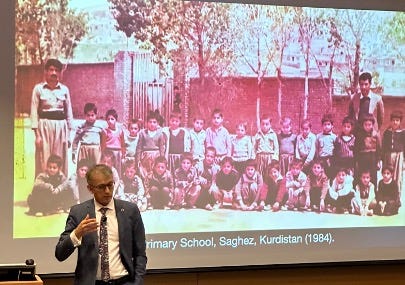
In the morning, Kak Brayim (Ebrahim Karimi) gave a heartfelt address about the extraordinary circumstances that saw him go from an unassuming boy from Seqiz, Eastern Kurdistan—about 100km south of my own town of Mehabad—to one of the world’s foremost experts in quantum physics. Recounting a particularly difficult childhood episode in which he had a brush with death, his voice started to crack as he was clearly fighting back tears. After taking a moment to recompose himself to the sound of applause, Kak Brayim admitted that he had shared his story at previous venues without so much as a hitch in his voice. So why be on the brink of tears now if what he was telling us was nothing new? The truth is, it was new, because this had been the first time he had delivered it in Kurdish, his heart-wrenching mother tongue.
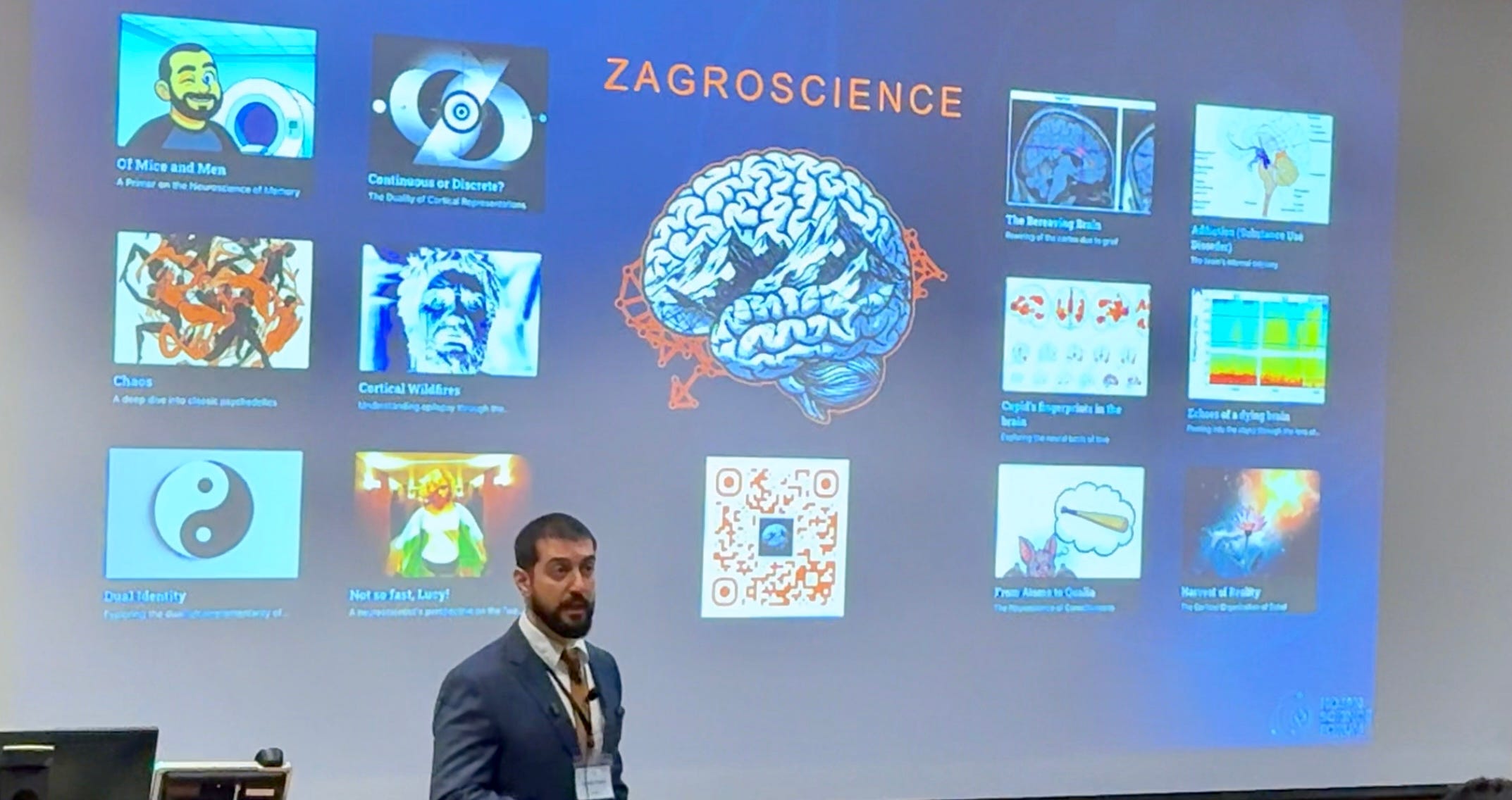
At last it was my turn to shine. I began by doing some housekeeping in Kurdish—welcoming everyone, thanking the organizers, and hoping that the conference would show the world that we, Kurds, have lots of brains to go with the brawn that everyone else attributes us. The rest of my talk I gave in English, starting with an introduction of who I am, where I did my PhD studies, and what topics I investigated, before shamelessly plugging ZAGROSCIENCE! I then talked about the 12th century Kurdish mystic, Sûrewerdî, and his views on how the mind organizes knowledge, segued into the three cognitive domains of relational memory, briefly discussed temporal lobe epilepsy as a well-established human model of memory impairment, showed off my own contributions to the field of memory research, and ended on a note about how consciousness itself might just be a glorified memory system.
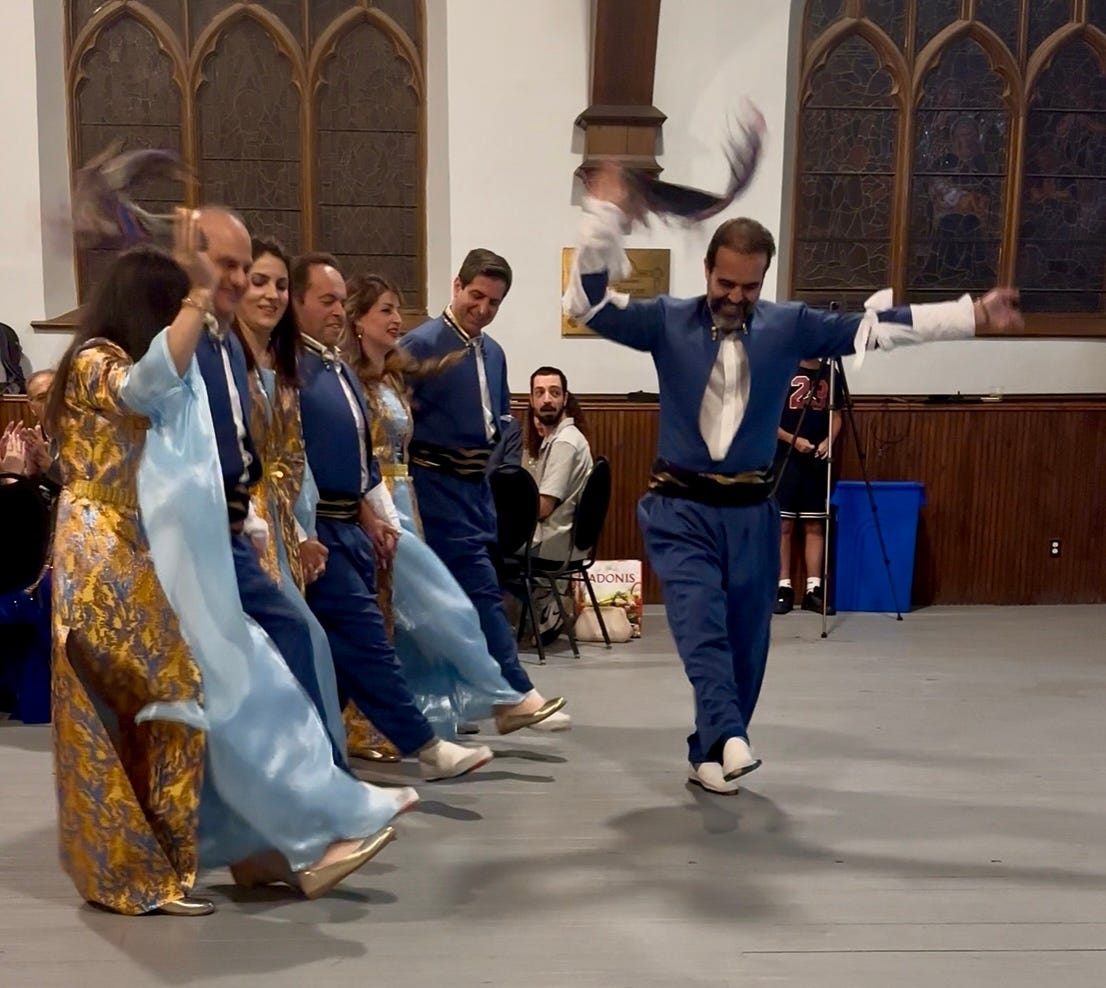
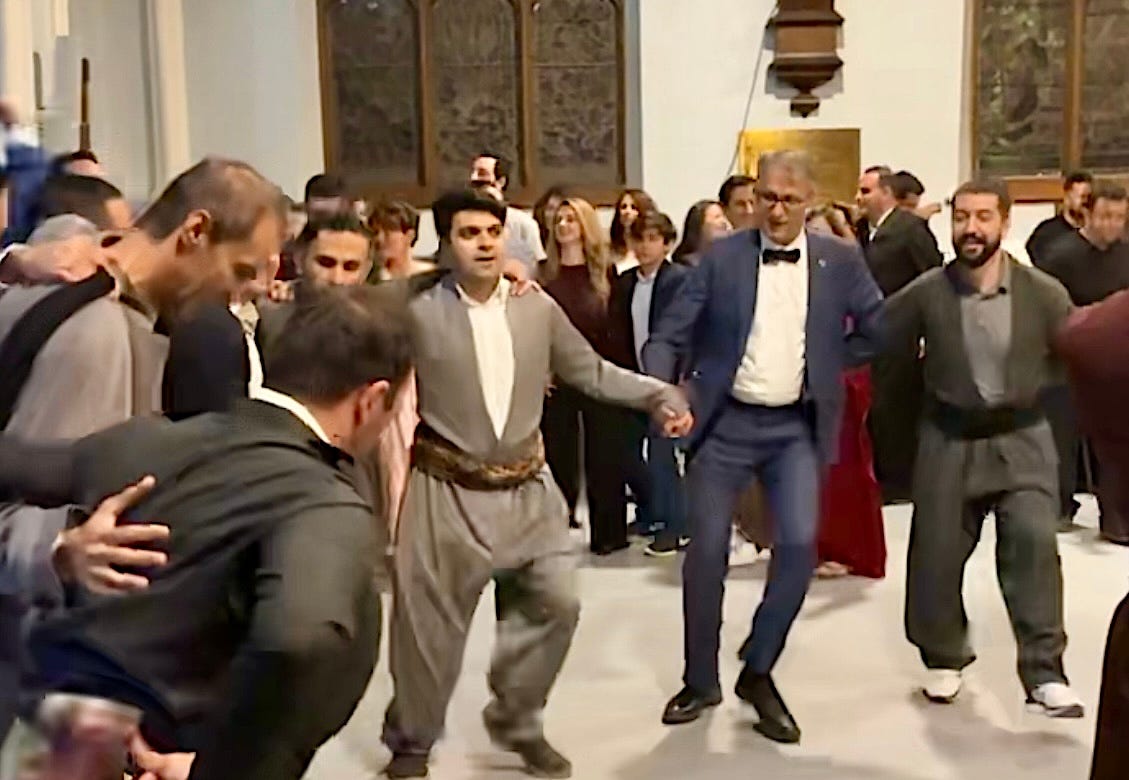
And then came the afterparty of the so-called cultural night. Yagi and I had gone back home to freshen up and prepare for the event. Miraculously, my wife had found two sets of traditional Kurdish clothes for us to wear. She had pulled them out of the closet in the master bedroom, but she might as well have conjured them up for all I know. I called Kake Showan for an update—he and the rest of his musical ensemble, Mesopotamia, were already on location for the sound check. “God I hope there won’t be a last minute issue with the sound system,” I thought to myself. Yagi and I left around 7:30pm, arriving twenty minutes later at the venue, a spacious Anglican Church built in 1899 and repurposed in modern times for hosting various gatherings. We were seated at the table closest to the stage with Kake Showan and the rest of the musicians. The evening started with a vibrant dance performance by the Kurdish group Kaziwe, which means twilight. After the colourful showing, a young man clad in Kurdish clothing took the spotlight, relating his story of how he discovered his true identity. Growing up in Xorasan, the largest Kurdish-inhabited region outside of Kurdistan proper, he had assumed for all of his childhood that he was Persian. Through no fault of his own, he had been taught Farsi instead of Kurdish and never told about his roots. It was only during his early adolescence that he found out that his Persian persona was a façade. He started questioning why his grandparents spoke the language they did, why the music that was playing at the corner shop was so alien to him yet so native to his soul, and why he simply could not shake the impression that he was different. And so, he embarked on a life-changing crusade for the truth, which reconnected him with his Kurdish ancestry, learning his beautiful mother tongue in the process. Kake Showan’s musical performance with Mesopotamia was next—as expected, it was unfortunately mired in technical issues with the sound system, which made it very difficult to hear his Kemançe. Even so, he delivered a stunning musical rendition worthy of the master that he is. The rest of the night saw the members of the Kurdish intelligentsia in attendance dancing hand in hand with the helperkê3 music blasting in the background. It was a good night!
Day 4 of Hojan (August 28)
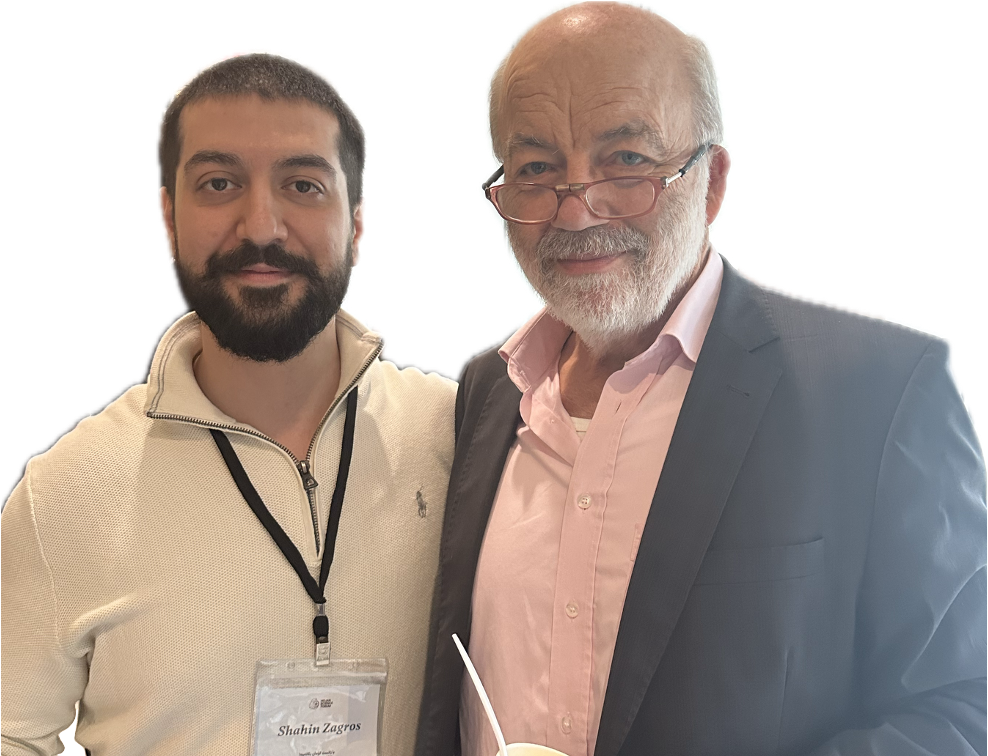
zzzzz… I slept in. I was recovering from the long day I had yesterday. I showed up just in time for the award ceremony and the closing remarks. I said my goodbyes to the organizers as well as the new contacts and friends I made along the way, including Gerd with whom I shared a hug. What a great experience the first Hojan Science Forum proved to be. Barring any unforeseen circumstances, I definitely plan on participating in the second Hojan Science Forum, whether it be held in the States, Europe, or better yet, the motherland Kurdistan.
Final thoughts
The 9th century Chaldean polymath Ibn Wahshiyya, known for having partially deciphered the Egyptian hieroglyphs long before the discovery of the Rosetta Stone, produced a manuscript of the world’s most ancient alphabets in 856 CE (Bin Wahshih & Hammer, 1806). In it, he showcased an intriguing writing system that he attributed to the Kurdish language. According to Wahshiyya himself, he had to postpone the completion of his linguistic compendium just so he could translate into the lingua franca of Arabic two books written in this Kurdish alphabet for the sake of humanity given the wealth of knowledge contained in them:
During my stay at Damascus, I met with two books, one of them on the culture of the vine and the palm tree, the other on water, and the means of finding it out in unknown ground. I translated them both from the Curdic language into Arabic, for the benefit of mankind. This is the reason this treatise was not finished before.
Much has been said about Wahshiyya’s work; some calling it an elaborate fabrication with others still professing its reliability—even though no other document bearing the Kurdish symbols has ever been found. But absence of evidence is not evidence of absence, and we may yet discover some lexical remnants of this mysterious Kurdish alphabet if Wahshiyya is to be trusted. Interestingly, he also stated that the Kurds proclaim to have received these symbols from their ancestor Bínúshád, who may have been the Sumerian King Ziusudra or Zin-Suddu, the last ruler before a purported Great Flood according to the Sumerian King List. How much of all this is history and how much of it is mythology is not my place to tell, as there are likely elements of both. What is noteworthy is that while Wahshiyya professed the superior wisdom of his own people, the Chaldeans, over all other races, he nevertheless spoke of the intellectual prowess of the Kurds too:
The Chaldeans were the wisest men of their times, being well acquainted with every science and art. Their first equals and rivals were the Curds.
He additionally recognized the primacy of the Kurds as cultivators, which is not surprising given that farming started in Kurdistan:
The first superiority the Curds had over them [Chaldeans], was in agriculture and botany.
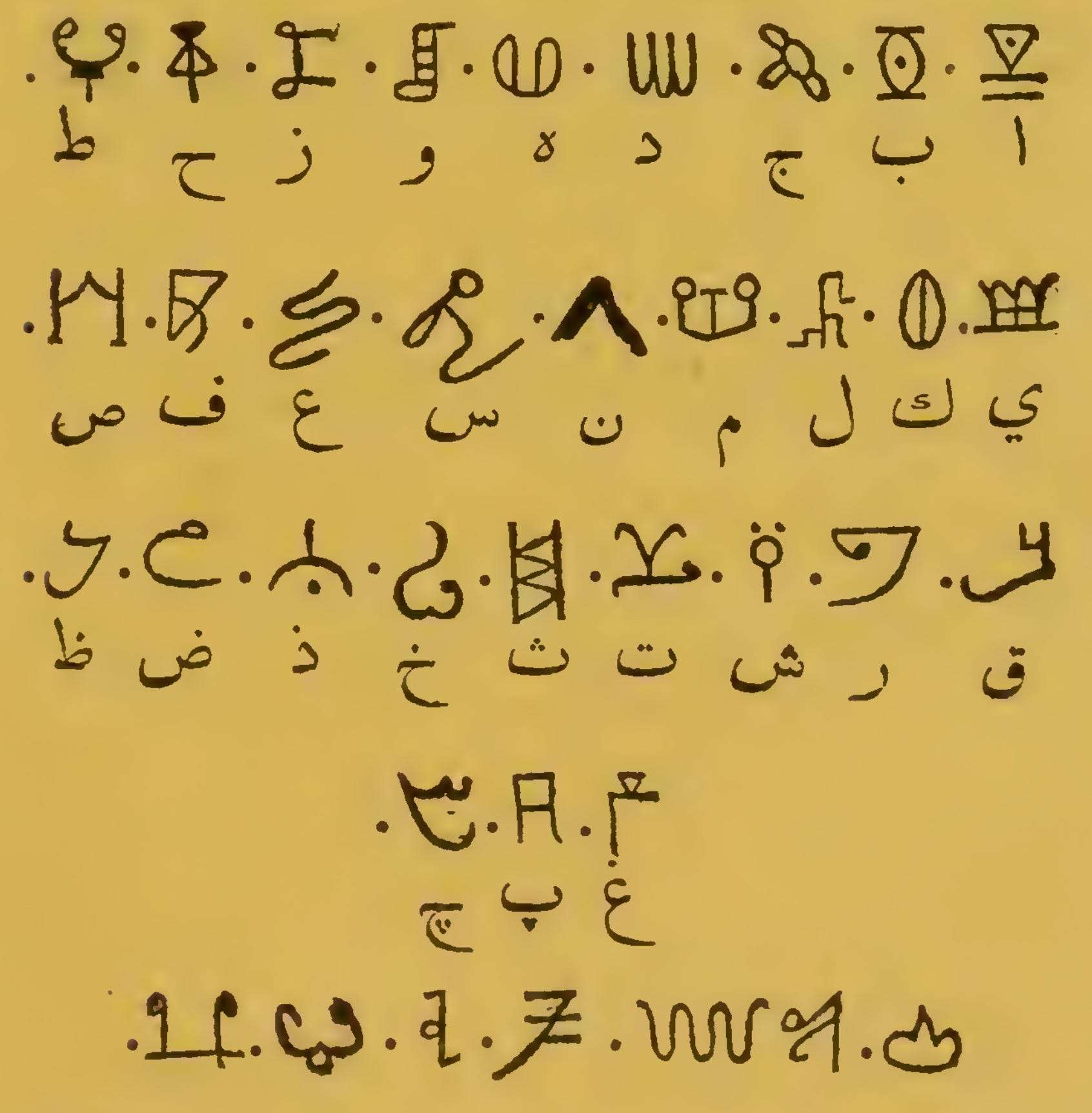
In recent years, the work done by historian Soran Hamarash has pointed to potential associations between contemporary Kurdish and ancient languages of the Fertile Crescent. Here are some examples from Hamarash (2022) in which the author makes direct comparisons between Sumerian and Kurdish:
Sumerian/Kurdish: ama/āma | mu/m | ki/cī | nu/nu stin | a/ā | nu/nā | nu/nu e “My mother does not sleep in the bed (sleeping place).”
Sumerina/Kurdish: nin/nana | aše/īse | še/co | ara/a hāre “The lady/old lady is grinding barley now.”
Sumerian/Kurdish: pap/bāb | mu/m | ussu/haš | asiri/asir i | bara/barā “My father released eight prisoners.”
Here is another striking example from the same book that juxtaposes the Hurrian/Hittite inscription found on the oldest known tablet pertaining to horse training (1,345 BCE) with modern Kurdish:
Hurrian-Hittite/Kurdish: UMMA/amma | Kiikkulili/kaikuli | LÚ/lāu | aaššuuššaanni/aspueseni | ŠA/žā | KUR/kur | URU/uār e | Miittaanni/mitāni
“Thus [speaks] Kikkuli, the horse trainer from the land of Mitanii.”
Hamarash maintains that Kurdish is a linguistic bridge between past and present, and to flesh this truth out, he suggests categorizing it as “Zagrosian,” which is to say, native—just like its speakers, the Kurdish people—to the Zagros mountains, the very same region of the world that sits at the heart of all Indo-European languages.
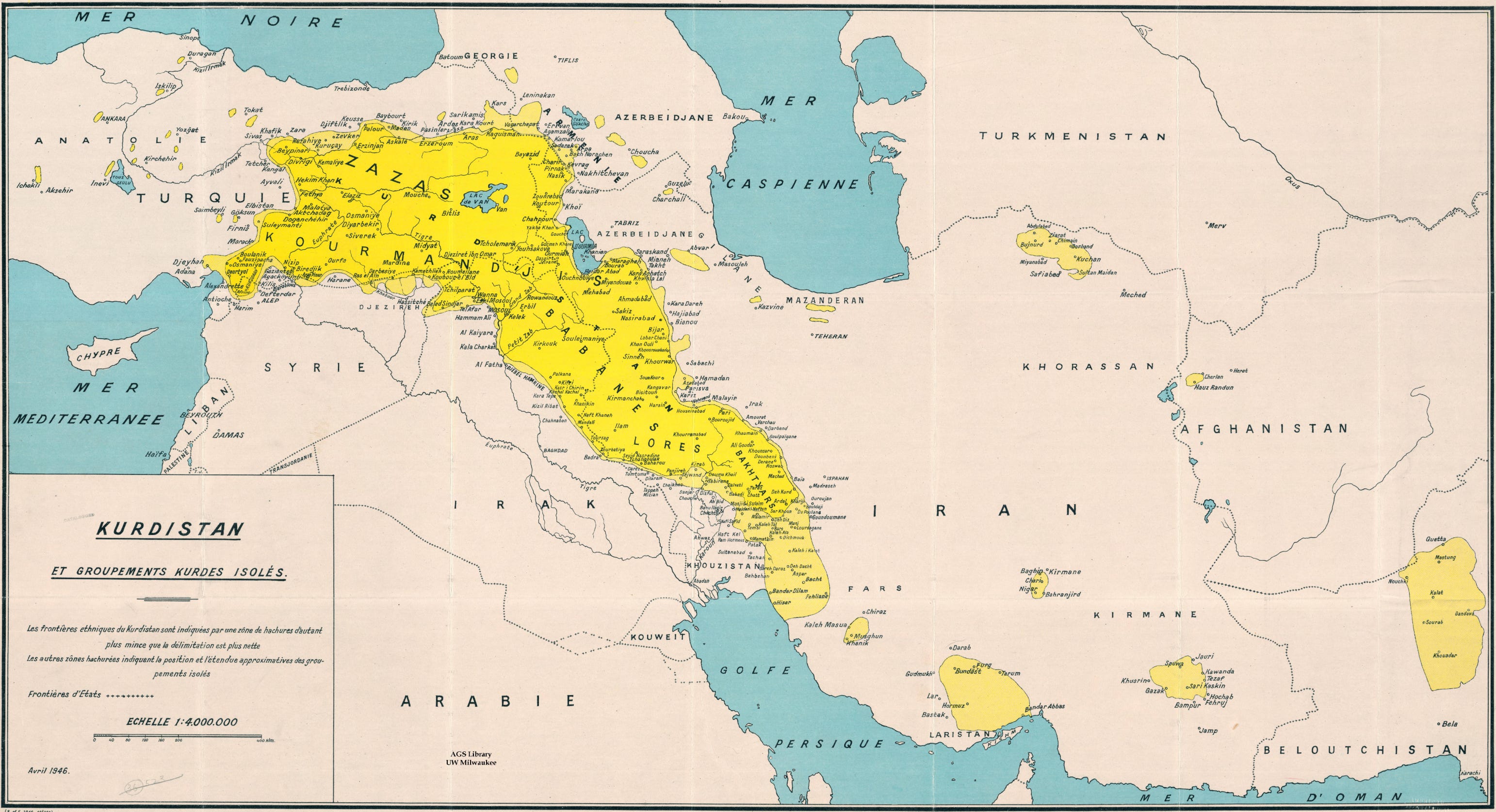
If the Hojan Science Forum taught me anything, it is that scholarly work appears to be the surest way of acknowledging the significance of Kurdistan, especially since its geopolitical recognition constitutes a shared red flag among Turkish, Iranian, Iraqi, and Syrian states. Even so, as alluded to earlier, whenever the Kurdish question is brought up in academia, politics somehow always finds a way of rearing its ugly head. I am reminded of a specific instance involving another brother-in-law of mine, Dana, who is the co-author of a chapter in a book about the plight of refugees (Abu-Laban et al., 2024). The section in question (Harrington & Waissi, 2024), titled Locating Kurdish Cultural Identity in Canada, discusses how literary and musical creations enable diaspora Kurds living in Canada to express their uniqueness. To provide some geographical context for who the Kurds are, Dana had originally planned to include a complementary map of Kurdistan in his introduction. He had ensured that all the inclusion criteria pertaining to the use of images in the body of the text were met, including quality, resolution, and format. Together with the other co-author, he had even acquired permission from the American Geographical Society Library of the University of Wisconsin-Milwaukee Libraries to use the map in question, even though it is openly accessible on public domain. Even so, the publishers decided that, for reasons that were never really made clear, the image did not meet their standards of publication. Based on personal conversations I have had with Dana on this matter, it appears that the publishers and editors were trying to avoid controversy at all cost. For a book that purportedly strives to give a voice to the dispossessed, refusing to showcase a simple map of Kurdistan in a chapter about the Kurds—arguably the single most disenfranchised group in the world—reflects very poorly on the entire project.
Even news agencies in the semi-autonomous region of Southern Kurdistan must tread carefully when reporting on events pertaining to other parts of Kurdistan, lest there be unwanted political repercussions from the surrounding nation states. I have recently learned from a contact who works at Rudaw, one of the region’s biggest media broadcasting companies, that the Turkish government has warned that the use of the expression Bakur, the Kurdish term for Northern Kurdistan, in journalistic correspondences will be seen as an act of provocation against Turkey that will incur diplomatic problems with the Kurdistan Regional Government in the state of Iraq.
Herein lies the importance of grassroots initiatives like the Hojan Science Forum. As non-political, borderless organizations, international conventions like Hojan have the potential of fostering enduring intellectual spaces conducive to the promotion of the Kurdish identity. By holding regular meetings of the sort, in which science, history, art, and philosophy flourish in the Kurdish language, Kurds can, not only partake in, but drive the conversations that shape the world. And while this world has been unjust to us, refusing to acknowledge our history, language, land, and sometimes, even our very existence, we Kurds are not victims—we are the descendants of the Sumerians, Gutians, Mitannis, Medes, and Manneans; the offspring of the Dragon’s union with the Mountains; the children of Kawe, the mighty Blacksmith who vanquished the tyrannical Zuhak. So it is incumbent upon us, the new generation of Kurdish scholars, scientists, and thinkers to pave the way for our children, so that they may never forget who they are, never underestimate themselves, and never feel inferior to the children of our neighbours. It was Martin Luther King Jr. who dreamt of a world where little black boys and black girls would be able to join hands with little white boys and white girls as sisters and brothers. In the same spirit, it is my dream that one day, my beautiful soon-to-be-three-year-old daughter, Waran, grows into the fearless Kurdish lioness she is poised to become, and to walk, unashamed, unfettered, and unapologetic, shoulder to shoulder, and as an equal, among her Turkish, Persian, and Arabic friends. As the Hojan motto goes: ba zanist koman bikatewe - let science unite us.
References
Abu-Laban, Y., Frishkopf, M., Hasmath, R. and Kirova, A. eds., 2024. Resisting the Dehumanization of Refugees. Athabasca University Press.
Ali, A., 2025. ئەیوب عەلی - کۆنسێرتی شاری بەرشەلۆنە. [online] YouTube. Available at:
[Accessed 10 Aug. 2025].
Bin Wahshih, A.B.A. and Hammer, J., 1806. Ancient alphabets and hieroglyphic characters explained; with an account of the Egyptian priests, their classes, initiation, and sacrifices. W. Bulmer & Co. Cleveland Row.
Hamarash, S., 2022. The Lost and Untold History of the Kurds: Rediscovering the Beginning of the Western Civilisation and the Origin of the Indo-European Languages, ca. 10000 BC- 1300 CE. Iraq: Self-published.
Harari, Y.N., 2014. Sapiens: A brief history of humankind. Random House.
Harrington, L. and Waissi, D., 2024. ‘Locating Kurdish Cultural Identity in Canada’, in Abu-Laban, Y. et al., Resisting the Dehumanization of Refugees. Athabasca University Press, pp. 303-327.
Heggarty, P., Anderson, C., Scarborough, M., King, B., Bouckaert, R., Jocz, L., Kümmel, M.J., Jügel, T., Irslinger, B., Pooth, R. and Liljegren, H., 2023. Language trees with sampled ancestors support a hybrid model for the origin of Indo-European languages. Science, 381(6656), p.eabg0818.
Orwell, G., 1996. Animal Farm. Signet Classics.
Kak/Kake is a Kurdish term of endearment used when referring to or speaking with another man, typically as a sign of respect towards an older brother.
GHG: Caucasus hunter-gatherer
Helperkê is the ancient, traditional Kurdish dance in which boys and girls, men and women, young and old, all join hands together in repeating, synchronized dance patterns as the emergent human chain moves about in a circular procession.
Correction to audio
1:43-1:45: “Scheduled for end of August…” NOT “Scheduled for end of May…”
It’s really nice to listen to your narration, especially for this one, reliving what was clearly a unique integration experience, merging the professional and personal in your authentic voice.
Wonderful post, I wish you continued good luck in your goal and journey