

Substack offered me a Faustian bargain - "As a neuroscientist," I turned it down...

If to the moment I should say:
Abide, you are so fair—
Put me in fetters on that day,
I wish to perish then, I swear.
~ Goethe (Faust)
MEA CULPA
Back in January, I hosted Mike X Cohen, PhD on my podcast, The Abstract, where we discussed the role of midfrontal theta oscillations in response-conflict processing. At the outset of the episode, I announced that I had been drafting an article pertaining to the spread of pseudo-(neuro)science on social media (see video below). I was hoping to publish my piece sometime in February, but my plans got significantly derailed… Early that month, through no fault of my own, I was hurled into a living nightmare, a Kafkaesque reality that is still looming about, which effectively upended some of my priorities in life. When the time is right, I will go public with my story to raise awareness about what my family and I have had to endure in the hopes that no one else suffers the same fate—which, given the nature of human psychology and bias, is, perhaps, wishful thinking on my behalf… I won’t elaborate any further for now, but rest assured that everything will be made clear in due time.
Compounding my personal problems is the ongoing geopolitical unrest that has recently intensified across my homeland of Kurdistan. My platform, ZAGROSCIENCE, is dedicated to exploring the interface between neuroscience and other disciplines, such as philosophy, literature, history, and mythology. I have deliberately veered clear of political commentary, because it tends to be combustible. A simple perusal of discussion threads on social media outlets about global affairs suffices to drive this point home, and while I don’t necessarily think it’s always a bad thing to engage others in a heated factional disagreement, I believe the inevitable vitriol that oftentimes follows serves little to no purpose in discussing the brain/mind. Even so, my intentional omission of politics on this platform should not be misconstrued as an admission of apoliticality. Like almost everyone else, I possess my own opinions on international and sectarian dynamics, and as a Kurd, I admit that recent developments in the Middle East have been weighing heavily on my mind.
I should clarify that my relative inactivity on Substack as of late is not solely due to grievances—personal or otherwise; we all have our own daily demons to deal with, and I’ve never been one to kowtow in the face of adversity. As it turns out, throughout these difficult times, most of my cognitive bandwidth has been taken up by a grand project that I started about two months ago, which, I’m hoping, will lay the groundwork for how social media is used in the future—and I’ll be elaborating more on this initiative as the year progresses. Social media, in fact, is at the heart of this article, wherein I examine the corrosive effect of its Faustian bargain on the intellectual and moral integrity of individuals who specifically write and talk about neuroscience.
INFERNAL PACT
So, what exactly is a Faustian bargain? For starters, Faust is widely recognized as Goethe’s magnum opus, a timeless play hailed as a crowning achievement in German literature. It tells the story of a cosmic wager between The Lord and Mephistopheles centered around the nature of the human soul. As they set their sights on Faust, the titular protagonist, a doctor with a brilliant albeit dissatisfied mind, The Lord agrees to allow Mephisto to attempt to corrupt him with worldly delights (e.g., knowledge, pleasure, power, etc.), reassured that a striving good man, no matter how much he may stray, will always find the path to righteousness. Speaking to Mephisto, The Lord says:
Enough—I grant that you may try to clasp him,
Withdraw this spirit from his primal source
And lead him down, if you can grasp him,
Upon your own abysmal course—
And stand abashed when you have to attest:
A good man in his darkling aspiration
Remembers the right road throughout his quest.

Mephisto then appears to Faust in his study dressed as a traveler and makes him an offer. He swears to serve Faust on Earth and try to satiate all his mortal aspirations, offering him unbridled worldly experiences, if Faust pledges to accord Mephisto his soul in the afterlife in the event that he reaches a moment of complete contentment, wishing it to linger forever:
If to the moment I should say: Abide, you are so fair—Put me in fetters on that day, I wish to perish then, I swear.
In today’s digital world, Mephisto appears to us in our phones, computers, and tablets. And just like he made the good doctor his target, he is inclined to single out those among us who are seekers and purveyors of knowledge. In the next paragraphs, I will give examples of some such individuals who have fallen under Mephisto’s spell—people with large online audiences who have accepted the Faustian bargain of bountiful clicks, likes, comments, posts, and restacks—not to mention money—in exchange for their intellectual and moral integrity.
LOST SOULS
Consider the following note taken from an academically credentialed individual who curates of one of the largest “neuroscience” platforms on Substack1:

Ah! Now you know where I got my title from, but I’m sure many of you already had a hunch…
Starting off the sentence with As a neuroscientist, which is a hallmark of the author’s social media shtick, is their way of indicating that they are speaking from a place of authority. They’re essentially saying, “Listen to me, you plebe, because I know more than you.” Otherwise, if not to signal their self-proclaimed intellectual superiority, it’s unclear whether they mean that one needs to be a neuroscientist to appreciate the effects of showering in the dark, or it is thanks to neuroscientific investigation that they’ve concluded that showering in the dark can lead to resetting the nervous system. Also, what is actually meant by to reset my nervous system? Presumably, the author is saying that you should shower in the dark, because you’ll feel good afterwards. But how is that the same as resetting your nervous system, whatever that means? Indeed, the wording is vague, lazy, and disingenuous, offering no scientific context whatsoever to support his claims, other than, “Trust me, bruh!” The entire note, which masquerades as neuroscientific insight, basically boils down to an appeal to authority mixed with pseudoscientific fluff. Here’s how I’d rewrite it:
Behold, feeble-minded peasantry! Heed my words for I am thy purveyor of truth, and I hereby decree, “Fluff-a-dee-doo-dah!” and ye shall obey!
This person’s Substack page is a well of opportunities for this kind of dissection, so let’s do another one.
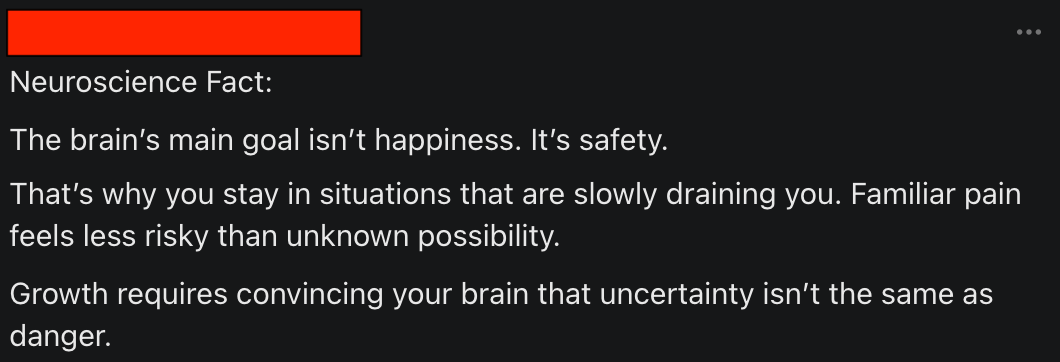
I love the above note, not because it offers a Neuroscience Fact—it doesn’t—but because it’s a prime example of the mind-numbing and intellectually corrosive effect of Substack’s Faustian bargain. Let’s break it down.
The brain’s main goal isn’t happiness. It’s safety.
Your brain—with its 65-85 billion neurons and 40-50 billion glial cells—is an intricate constellation of living tissue that performs highly elaborate operations, such as regulating autonomic functions (e.g., heart rate, blood pressure, breathing, etc.), controlling movement and coordination, processing sensory information, managing emotions and basic drives, and enabling higher cognitive actions. To suggest that it serves a singular main goal—whether it’s happiness or safety—grossly oversimplifies the functional complexity of the human cortex, and no self-respecting neuroscientist that I know would ever allow themself to publish such an intellectually lazy and sloppy statement.
That’s why you stay in situations that are slowly draining you. Familiar pain feels less risky than unknown possibility.
This segment builds on the false premise that your brain has a main goal and that this main goal is safety—whatever that means. Even assuming that the presupposition is correct, we’re still left with a general statement about how familiarity breeds decay and stagnation even if it feels safe. How this kind of cheap psychological triteness qualifies as a neuroscientific fact is beyond me.
Growth requires convincing your brain that uncertainty isn’t the same as danger.
I always cringe at language implying the existence of an agent that is independent of the brain that can somehow effect change upon it, such as convincing it to act one or the other way. That which we take to be the hub of our innate agency, from a neuroscientific perspective, is yet another layer of what the brain does, which is to say the construction of the ego or the sense of self. As a neuroscientist—which is what the author insists they are—making such an implicit distinction between the ego and the inner workings of the brain that give rise to it betrays either a fundamental lack of understanding of the underlying science or a disregard of it. Otherwise, the sentence articulates the idea that personal growth requires some measure of risk taking, which is basic wisdom. Good sense and sound judgment are free cognitive commodities that you should already possess—no fancy degrees in neuroscience needed—so be wary of professional swindlers who are trying to sell them to you.
Let’s turn our attention to another premium “neuroscience” platform on Substack and see what other golden nuggets we can excavate.
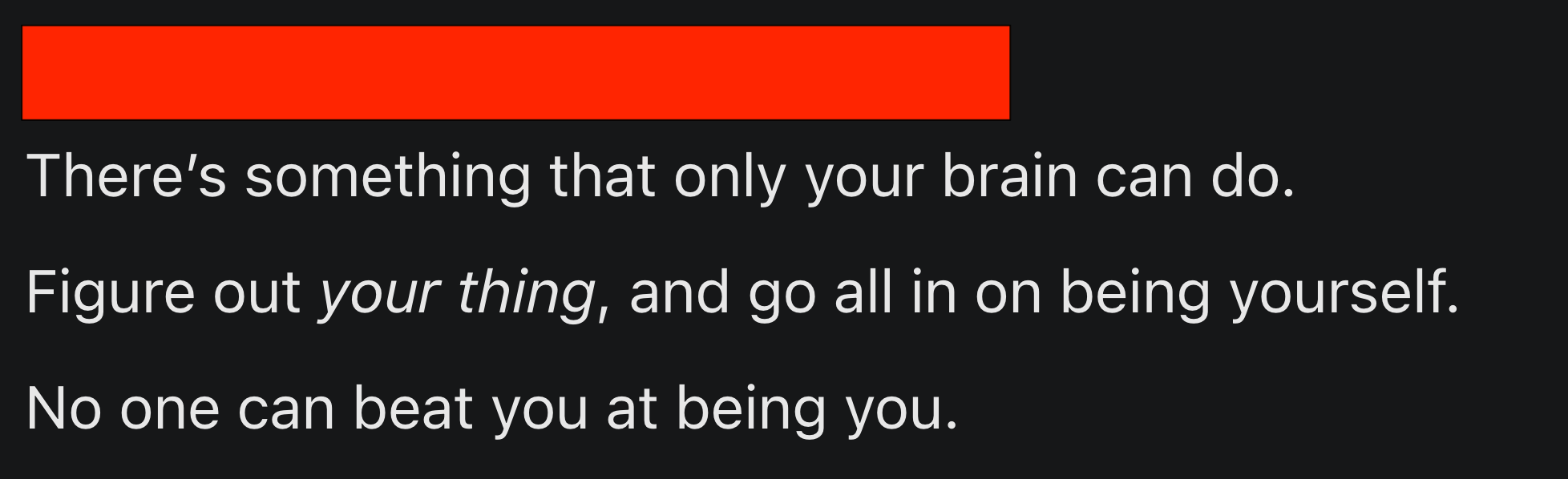
I’m going to need a sturdy pickaxe for this one…
There’s something that only your brain can do.
Enlighten me…
Figure out your thing, and go all in on being yourself.
Your thing? Go all in on being yourself? Woolliness passing for profundity—this is what I make of it; the equivalence of saying something without actually saying anything, akin to, “no one is as good as I am at being myself.”
No one can beat you at at being you.
No 💩, Sherlock!
Overall, the kind of redundant, vague, and circular tripe expressed in the above note is what I would describe as manifested mental constipation. It almost feels like the author—who has a PhD in cognitive neuroscience, mind you—is trying to push something big out…and then nothing comes out, except forced effluvium!
Here’s another example from the same account:
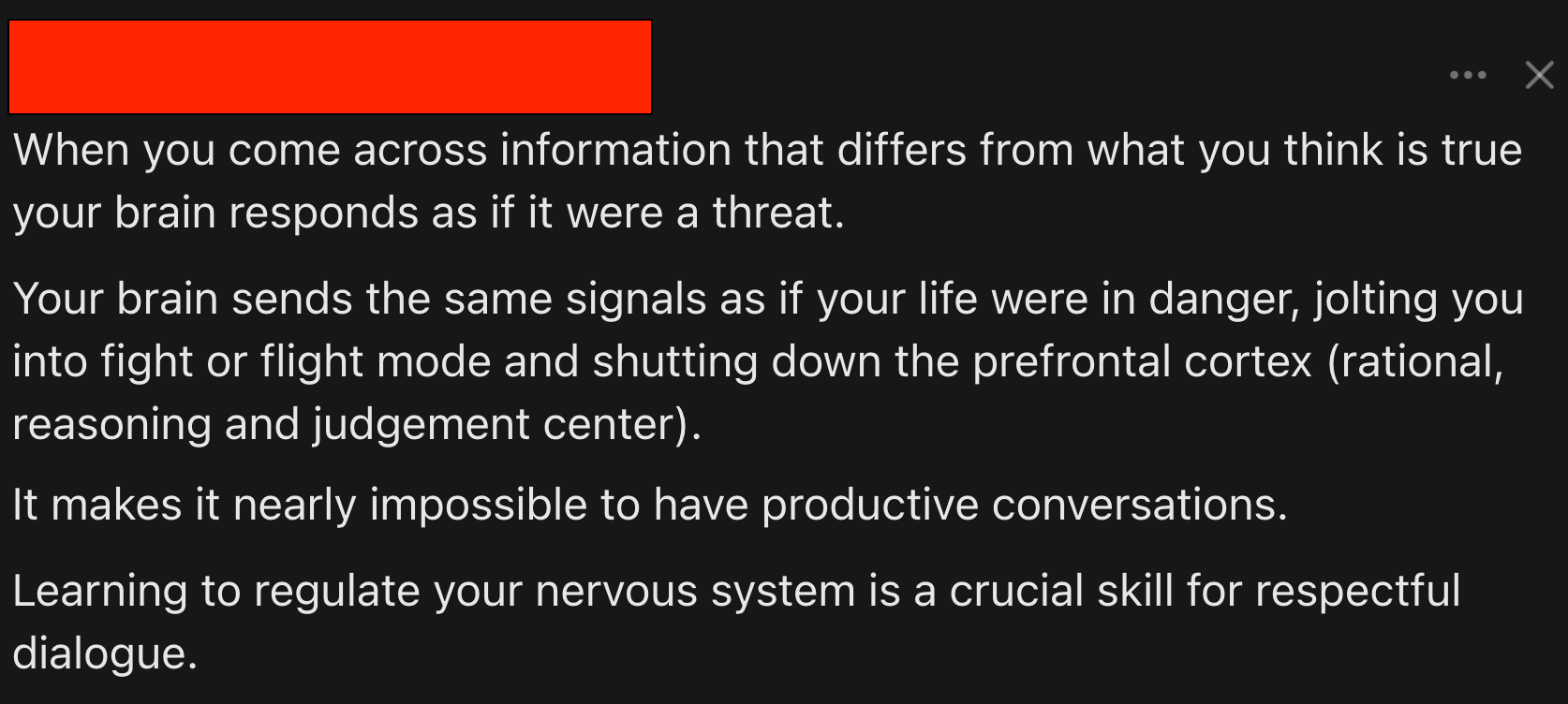
For starters, there is very little actual neuroscience in this note, and whatever is there is ambiguous.
When you come across information that differs from what you think is true your brain responds as if it were a threat.
While there is a modicum of truth to this statement, the wording lacks clarity and context. Your brain constantly compares information it receives from the senses to pre-catalogued models of how the world is supposed to be. When a prediction error occurs (e.g., a mismatch between expectation and observation), the cognitive model generally updates to accommodate the new information, sustaining flexible behaviour and learning. This process does not always trigger fear—if it did, we would be constantly aghast. Prediction error and model updating represent continuous and complementary features of the inner workings of the brain, spanning multiple tiers of information processing (e.g., low-level perception to higher order executive functions). In fact, even when it comes to information that contradicts an opinion—which is really what the note is about—unless said opinion is deeply rooted within one’s sense of identity, it is not necessarily the case that your brain will set off the alarm. I have written at length about this very topic, so if you’re interested in the neuroscience/psychology of belief formation and revision, I invite you to read my post, Harvest of Reality: The Cortical Organization of Belief.
Your brain sends the same signals as if your life were in danger, jolting you into fight or flight mode and shutting down the prefrontal cortex (rational, reasoning and judgment center).
How theatrical! Nuance is everything, and without it, it’s impossible to bear out the truth—but who cares about the truth when you can sound sexy, right? Does your sympathetic nervous system go into hyperdrive when your life is in imminent danger? Yes, absolutely. Is this reaction the same kind of fight or flight response as when, say, someone disabuses you of the false notion that the capital of Australia is Sydney? No! Nuance, people…nuance! Also, no—your prefrontal cortex (PFC) does not shut down either. Imagine being chased by a hungry lion in the African savanna. Fight or flight? You bet! Now imagine what would happen if your PFC actually shut down. Let me paint you a clear picture. Gripped with abject terror, the weight of inertia would come crashing down on you during your fleeting moments of life as the giant feline pounces on you, transpiercing your throat with its long, dagger-like canines. You see, since the PFC is heavily involved in decision-making and planning, you wouldn’t be able to choose what course of action to take (e.g., run, hide, climb a tree, etc.), so you’d be frozen in place, which is fine…if you’re the lion. Your fight or flight response is evolution’s way of telling you to move your ass if you don’t want to end up as kitty chow; it would be a pretty lousy survival mechanism if it did the equivalence of a PFC lobotomy every time you found yourself in harm’s way. The author could’ve used another expression or term to convey something more accurate—and less dramatic—like “downregulating” or “reducing the activity of” the PFC. Again…nuance, people.
It makes it nearly impossible to have productive conversations.
Learning to regulate your nervous system is a crucial skill for respectful dialogue.
Ok, be mindful of what you say when you disagree with someone if your intention is to have an open-ended, honest conversation with them. But what’s the point of this note? If the purpose was to reveal something worthwhile about the brain and the sympathetic system, I dare say the author missed the mark as the neuroscience it conveys is very weak. Otherwise, if the motive was to provide commentary about general etiquette and respect, then why have recourse to all that fluff about the brain? This is not neuroscience, ladies and gentlemen. This is garbage, which—if you’re a premium subscriber to the account in question—you pay to consume. I can’t imagine this kind of bunk being healthy for your brain…
Sometimes, these professional online grifters spread lies that can be downright dangerous. Take the following note, for instance, curtesy of Mr. As a neuroscientist:
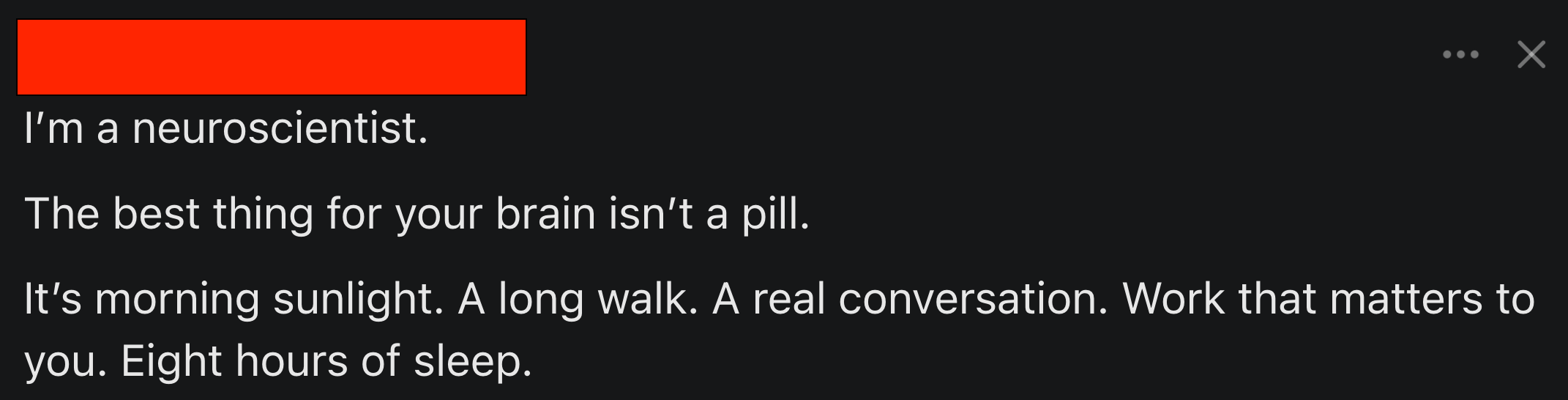
For shame, Mr. As a neuroscientist, for shame!
I’m a neuroscientist.
You don’t say!
The best thing for your brain isn’t a pill.
Tell that to the person diagnosed with temporal lobe epilepsy who needs to take antiepileptic drugs to control their seizures, or the one suffering from Parkinson’s disease who depends on levodopa-based medications to bear with all the tremors and rigidity, or even someone who is at risk of stroke who must take anticoagulants to keep it at bay. This kind of one-size-fits-all, blanket statement is both unscientific—as it fails to distinguish between different population cohorts—and deleterious—as it can potentially cause actual harm if acted upon.
It’s morning sunlight. A long walk […]
Sure, buddy. Go take a hike, why don’t you?
REDEMPTION
In his final moments, Faust’s unyielding resolve vis-à-vis his altruistic vision of creating a free society for humanity is what ultimately redeemed his soul. After all that Mephistopheles had conjured up to lead him astray, Faust still actualized The Lord’s conviction that, even at his darkest, a good man cannot be deterred from the path of righteousness. And so, there is yet hope for the so-called neuroscientists whose notes I have used as case studies for the perversive pull of Substack’s Faustian bargain. To be fair, not everything that they—along with countless many other online grifters—have said or written is false or disingenuous, but a lot of it is, which is a testament to the intellectually and ethically corruptive sway that social media recognition can have on weak and fragile individuals who are morally flexible. Clout, money, fame, influence, power…these are all things that you can eventually acquire with the right combination of planning, execution, and luck, but once you bequeath your soul to the proverbial devil, you may never get it back. I’d be lying if I told you that the thought of dancing with said devil never crossed my mind—indeed it possesses undeniable magnetism for someone with my academic pedigree—but I didn’t go to the trouble of obtaining a PhD in cognitive neuroscience from one of the top institutions in the world just to peddle internet claptrap and become famous for it—no thanks! Instead, I remain steadfast in my commitment to sharing with you the science of the human brain as truthfully as I can within the limits of my knowledge, which, when it comes to personal integrity, is a lot more than I can say about pseudoscience peddlers, those with and without fancy University degrees and accolades. Like any self-respecting online writer or podcaster, I too am motivated by self-interest, but never to the point of trying to sell my subscribers, followers, and viewers half-baked concepts, redundant facts, and superfluous noise, if not brazen lies—which, nowadays, are stupidly easy to produce en masse thanks to cheap AI ghostwriters. So to those consuming this kind of bunk: don’t, you’re better off getting a lobotomy instead (I was going to say “eaten by a lion” but that’s too much). And to those promoting it: it’s not too late for a course correction; your soul—or at least what’s left of it—may depend on it.
I chose to redact the identities of the social media grifters whose works I criticize in this piece, because my intention is not to single out anyone in particular, but to highlight the asininity, vagueness, and triteness of their online content, which constitute the modus operandi of almost all neuroscience snake oil salesmen.
Would you be ok with me turning this into an Instagram post? You’d get full credit of course and I’ll link to this article - it’s just, I have a vision 👀
“what is actually meant by to reset my nervous system?” EXACTLY.
As a stress physiologist (😄 couldn’t resist)… the whole “reset your nervous system” thing is total bullshit.